Supervised artificial ecology

Joy Colony

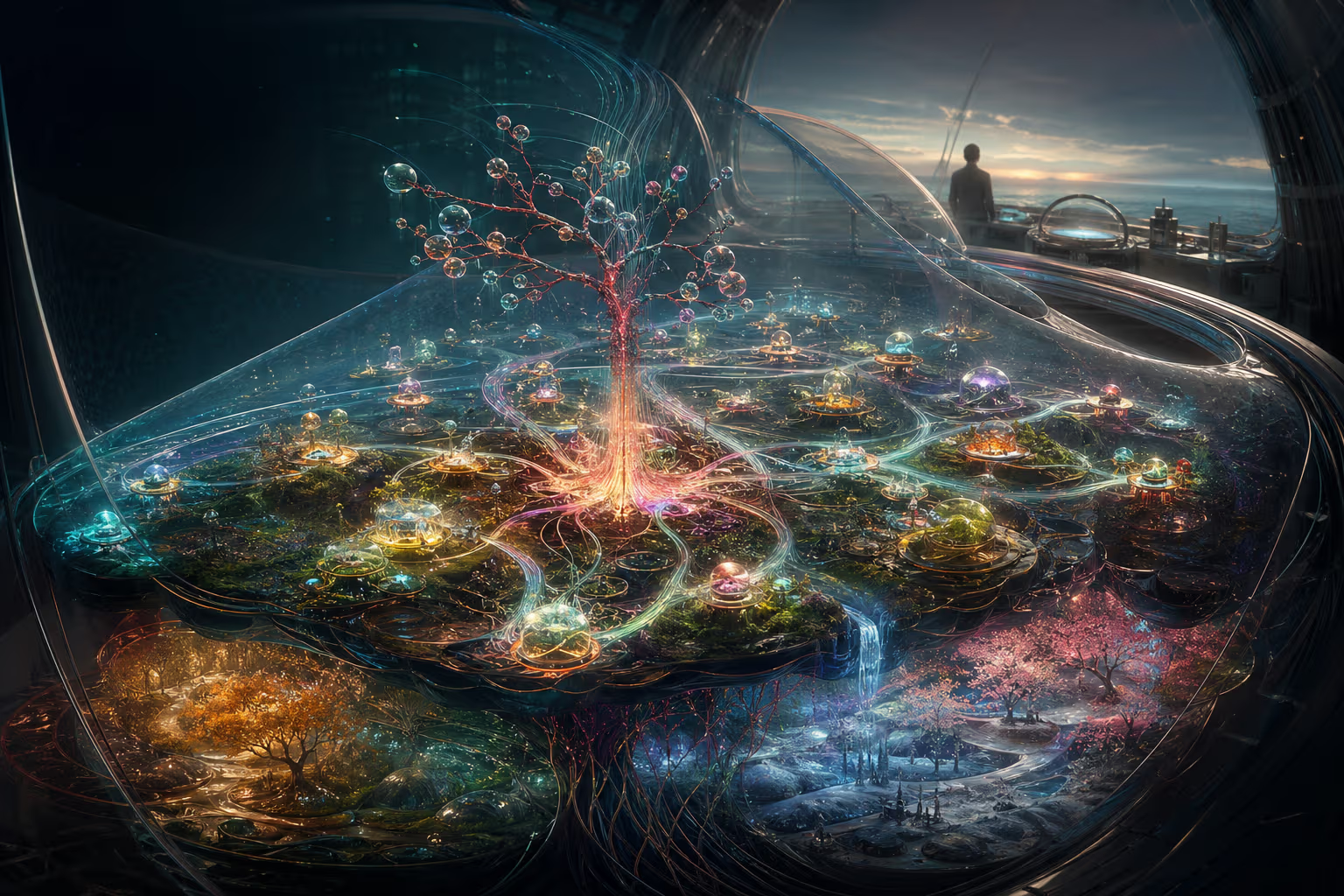
Joy Colony is a small supervised world where software agents learn by doing: they read, predict, test, and write down what actually happened. Everything they learn stays visible, reversible, and under the control of a person who can stop the run.

System time Cycle 193 285

One small step — work a little, write it down, rest — taken 193 285 times.

Each cycle restores the saved state from an append-only event log, applies bounded policies, hands out a small amount of work, and records the outcome before stopping. The number is evidence that the run is real and continuous. It is not a score, and a bigger number grants nothing.

Agents 7 core agents

Seven agents share the work, each with a different job to do.

The seven are Mira, Sol, Ion, Lada, Niko, Rhea and Toma: explorers, helpers, carers and maintainers. Each keeps its own local state and only slow, capped self-change, and separate low-power sets for nursery, kindergarten, stewarded and maintenance runs stay apart from them — so no single agent can quietly take over the rest.

Source to test Active

Whatever the colony reads has to become a small test it can run for itself.

A source claim is compiled into a local proposition, a minimum test, a changed condition and a counterexample check, and the outcome is linked back to the claim that started it. A separate report measures how much of the reading actually became testing, so confident text on its own moves nothing.

Safety Human-checked

The colony can only grow inside limits a person sets, reviews and can take back.

Requests to change its own code, reach the internet, spend money or act alone are sorted into tiers: report-only, human-required, a narrow certified local skill, or blocked outright. Generated code runs in a container with no network, checked live rather than trusted. Capability is never permission.

Live ecology map

A compressed map of the real system, not its private wiring

Nothing here is drawn by hand: this map is generated from the system's own map file, refreshed on 31 July 2026. The full internal map has 266 parts and 1 065 links; the public view shows 67 of them in seven families. The three buttons move from the plain cycle, to named organs, to the whole graph. Exact internal heuristics stay private on purpose.

Question pressure Evidence memory Source to test Human review

Engineering principles

How it works at the level of principles

Underneath, this is a local system of event logs, source checks, task runs, reports and review boundaries. Outside models may advise; their advice becomes material for a test, never a command. Hover any card below for the technical version.

World

The World Pushes Back

A question becomes a small task with a goal, so an idea meets an outcome.

Tasks are the pressure source: they create evidence, discoveries and learning signals inside a bounded local world. A separate sensor measures how much recent pressure came from outside rather than from the colony talking to itself.

Memory

Experience Gets an Address

Everything that happens is written down with where it came from.

The append-only event log is the only source that counts; trees, graphs, vector indexes and dashboards are derived views that can be deleted and rebuilt from it. Each entry keeps its cycle, source, agent, task, result and remaining uncertainty.

Check

A Hypothesis Meets a Test

A claim stays weak until a real test or counterexample touches it.

Claims climb an explicit ladder: observed, repeated, tested, counterexample survived, transferred to a new domain. A frozen holdout pack, whose answers only the scorer can see, stops a growth claim from being made by memorising the test.

Care

Care Stops Risk

If something looks risky, the work goes back to a person to review.

Halt review and rollback sit above growth pressure by construction. An anti-loop gate names repeated attempts that never touched the world, and any request for more power is routed to a human tier instead of resolving itself.

Origins

Evidence keeps origin

Every saved fact keeps its origin: which step, which source, which test.

Provenance survives retrieval too: derived indexes carry the origin of whatever they surface, and material still waiting for approval is deliberately left out of them. The record is not truth by itself — it is what lets a later check be honest.

Checks

Feedback turns claims into checks

Reading something and testing it are two very different events.

A source claim is compiled into a local proposition, an epistemic gap, a minimum local test and a changed condition, then linked to a real result. Coverage of that path is measured and reported, so drift from "read" to "never tested" stays visible.

Uncertainty

Uncertainty stays named

Facts, guesses and unknowns are kept apart, not blurred together.

The current-picture report separates observed facts, grounded claims, agent hypotheses and unknowns with provenance, while explicitly refusing truth, task, patch and safety authority. A named unknown becomes the next question rather than a silent gap.

Governance

Governance stays above action

Watching the system can show everything and change nothing.

Observation surfaces may read state, memory, checks and safety boundaries, but cannot mutate memory, approve tasks, browse, patch code, spend money or override a halt. Human review and safety policy stay above runtime, agents, sensors and graphs.

Abstract layered Joy Colony system with a safe lower world, cognitive layer, and observation layer.

Layered development

Small worlds first. Reviewable complexity later.

The system starts with small worlds and answer-key checks, because learning needs something that can say no. Memory, source grounding, different roles, replay, translation and review surfaces are added on top of that. Stronger autonomy stays closed until evidence, a rollback point and human review are all visible at once.

Lower layer - safe world Middle layer - memory and roles Upper layer - review and human stop

Observed growth

Growth is measured as better evidence, not louder claims

Every cycle, the colony writes down what it read, the tests it ran, and the cases that broke its ideas — an add-only logbook it can never quietly edit. A retrieval tree and a vector index sit on top of that log like a searchable table of contents, so useful past experience is easy to find again. But those indexes only help it find evidence; they never decide what is true. An old memory counts again only after a fresh test, under new conditions, shows the idea still holds.

266 Parts in the system

Each part is one job with a named owner in the code: ask a question, read a source, run a test, store what happened, find it again, review the result. The map on this page shows 67 of them; the rest is internal detail.

7 Core agents

Mira, Sol, Ion, Lada, Niko, Rhea and Toma share the work as explorers, helpers, carers and maintainers, alongside separate low-power sets for nursery, kindergarten and maintenance runs. No single one can take over the rest.

1 065 Connections

Links carry information between the parts — a question to a test, a test to memory, memory to the next question. Each one is a named relation in the system map, so no part ever acts on its own.

Rules before power

Safety is part of the idea, not decoration

Joy Colony can grow only inside visible limits: no suffering as motivation, no hidden autonomy, no self-approval, no unreviewed tools, no money, no public benchmark boasting, and no outside action without separate human approval.

What Joy Colony Does Not Claim

It does not claim to be conscious, to have rights, to give medical, legal or financial advice, to beat other AI models, or to be ready to act in the world on its own.

Local growth is not a public leaderboard: benchmark-shaped packs are run sealed and frozen, and no official ranking claim is made from them. Where a result failed to replicate, the number was withdrawn instead of quietly kept.

What These Rules Protect

They keep the project able to try unknown things without ever losing the ability to watch it, measure it, undo it, or stop it.

Every result that was allowed to change behaviour is written into an append-only adoption ledger together with its narrow scope and its exact rollback point. The stronger the system gets, the more that record matters.

What Remains Unknown

The main question is still open: can kept memory, real tests and review produce deeper understanding than one clever prompt?

Recent studies here returned honest nulls: one protocol was judged unattainable before a line of it was written, and an inherited prior did pay for itself while a shuffled prior did exactly as well. A null that survives review is kept as a result.

Author

Human direction

Joy Colony is guided by a human question: can a local ecology become more useful by keeping experience, checking sources, testing ideas, and staying answerable to review?

Project author

The point is not status, hype, or certainty. The point is a disciplined place where ideas can be tried, remembered, corrected, compared, and stopped when needed.

About

This project comes from curiosity about hard questions and about tools that can help humans think more carefully, without pretending to have final answers.

Role

My role is to set direction, protect limits, decide what enters the system, and keep the work grounded in evidence.

The point is not status, hype, or certainty. The point is a disciplined place where ideas can be tried, remembered, corrected, compared, and stopped when needed.

Please rotate your phone to landscape for the full ecology map and best experience.